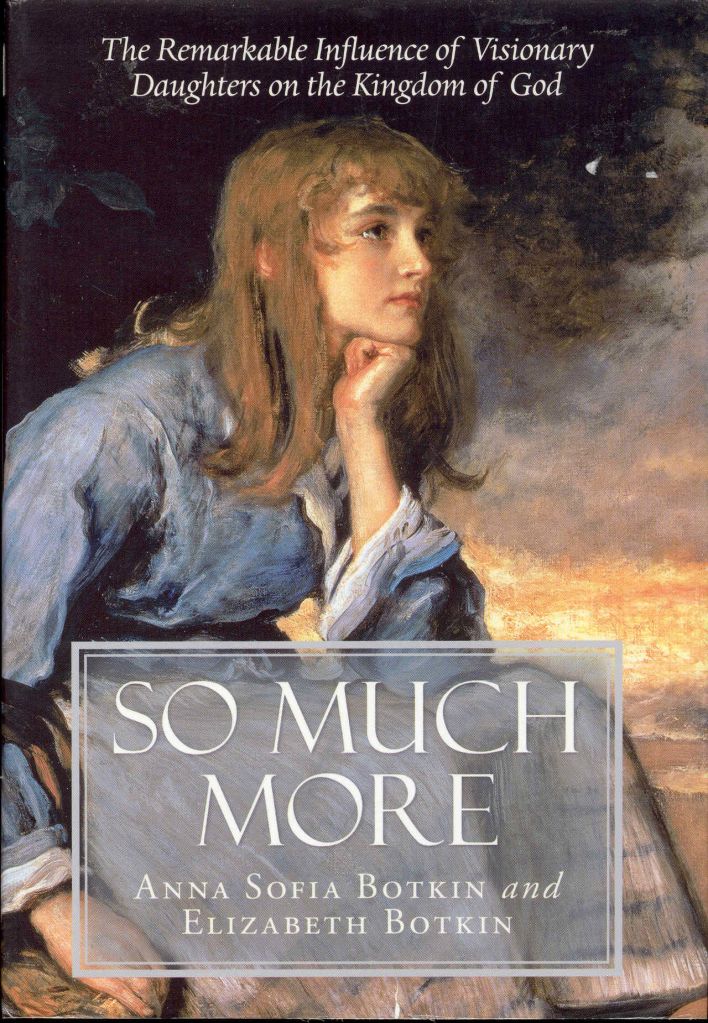
Written by two sisters, still in their teens at the time, So Much More is a book meant to encourage young Christian women to embrace a lifestyle pleasing to God, and to offer advice about dealing with questions and confusion that come from living in a culture that is becoming more and more opposed to God and to traditional values.
Let me begin by saying that I love the hearts of the Botkin sisters. They wrote So Much More out of zeal for a biblical way of life and with a desire to encourage and inspire other young woman to leave behind secularism and return to the traditional roles of womanhood. However, in their enthusiasm, they entered the dangerous waters of extremism. Nearly anything, when pushed to its limits, turns from good to destructive, and that is the case with many aspects of this book. Let me say here that I am 100% for biblical and traditional families and gender roles, and I agree with the Botkin sisters that feminism is not a liberation of women, but can be a tool used to infiltrate the most sacred part of society – the family – and destroy it. But we must be careful not to go too far in the opposite direction.
Many people who reviewed this book complained that it was full of legalism. While it is many things, it isn’t legalistic. We have made the idea of legalism such a huge deal that it is almost the worst sin a person could commit, and we are quick to justify disobedience with the words, “I don’t want to be legalistic about that!” Yet we are not free from laws simply because Christ came. In the Gospels, we see that Jesus was very serious about the fact that our outward actions will reflect what we believe. If we serve God, our actions will be in line with His commands. I have much more I could say on this subject, but as this is a book review and not a rant on legalism and the law, I shall return to the topic at hand.
I believe that So Much More has many excellent principles. One of the main themes was that young women should place themselves under the authority and protection of their fathers (or godly older brothers, uncles, grandfathers, etc. in the case of a father being absent). I agree with much of their point here. Fathers should be involved in every aspect of their daughters’ lives, and the daughters should welcome that involvement and rejoice in the love and protection that he offers. I love that the Botkin sisters share practical ways for fathers and daughters to work on closer relationships. I also appreciate that they acknowledge not everyone has a good relationship with their father, but that they encourage the daughters to continue working on it, to pray, and to not give up hope. While there was much good in the book, there were four chapters that I took issue with.
Should Women Work Outside the Home?
The Botkin sisters argue that, while there are occasionally times when a woman can work outside the home, in most cases, it is to be frowned upon. An unmarried woman should stay home and if she must work, it should be either in her father or brother’s business. If she seeks employment elsewhere, she is “pretending to be a man” and becomes a “wage slave”. A woman who allows her talents to be used outside of the home is throwing her gifts away.
God doesn’t call us to be isolated. As Christians we aren’t to live in our little communes alone – we are to go into all the world and tell of Him! Working is an excellent way to do this. I think back on the various conversations about God and faith that I had with co-workers. If I hadn’t worked with them for months, if I hadn’t had that trust built up, I never would have been able to share with them as I did. Our paths never would have crossed otherwise.
Much of this chapter speaks to married women with children, which doesn’t fit well in a book meant for single women still living with their families. I absolutely agree that mothers should, whenever possible, be home with their children and not in the workforce, but I understand that that is not always something that is practical or plausible whether for financial or other reasons. I completely disagree with the Botkin’s argument that unmarried women should not get jobs outside of the home. Personally, I’ve worked outside the home, and I’ve also worked with my dad in bathroom remodeling. I’ve enjoyed both jobs very much – one wasn’t better than the other. They were different and I’ve learned different things from each. Many young women may not be in a place where they have the opportunity to work with family members. What does that mean for them?
Should Woman Attend College?
This chapter had to be the worst for making subjective statements and setting them up as undeniable truths. The authors state that a young woman should absolutely never attend college as it will do nothing but corrupt and indoctrinate her (they say nothing about men).
They say that all colleges are evil (they’re basically schools of Satanism) and the goal behind every single college is to teach Marxism. These schools, they say, go against everything that the Bible teaches and even Christian colleges have been corrupted. Parents only send their children to college so that they can be “like the world” and not out of a genuine desire to help them succeed in life.
Oh dear.
Yes, many colleges are out to indoctrinate students. But that doesn’t mean that every single college is that way or that there is nothing to be gained in the pursuit of higher education. College was never a demand in my home, which I am thankful for. The choice was left to us, and I knew that I would never go simply for the “experience” or for the sake of the degree. If I was going to invest money and years of my life, it would be for the purpose of gaining knowledge that I would need in life. Hence, why I am now twenty-two and only just beginning college to study evangelism and missions work.
You can absolutely become indoctrinated and lose a solid Christian foundation by going to college. But you can also walk away stronger and with knowledge that will serve you for a lifetime.
Courtship & Marriage
I agreed with the authors that the American dating scene is awful and often causes heartbreak, infidelity, and brokenness to all parties. I love the idea of courtship and if I ever get married, that’s the way I want to do it. I want my father to be involved in every aspect of the process, and I want there to be strong physical boundaries (as a ten year old, I decided that I’d cover myself completely so that my future husband would never see anything but my eyes until we were married – my inspiration came from the story of Rebekah and Jacob, not Islam).
As happens so often in this book, the authors take good principles and push them to the extreme. They say that if a girl has a crush on a boy, it’s sinning, and that it is an act of mental infidelity to the future husband – she is no long a “one-man” woman. Of course, our thoughts are very important, and if we’re fantasizing about men that’s sin, but an innocent, girlish crush is certainly not the same as having pre-marital sex.
I was frustrated that they didn’t offer more practical advice for girls who will remain single. They touched on it briefly, but it was mainly, “Get married unless you are 100% sure that God has CALLED YOU into singleness – but even then, be ready to marry. Live in a constant state of anticipation.” Some of us may never get married, but that doesn’t mean that we are shut out from the blessings of a life lived to the fullest with God. Both Jesus and Paul have good things to say about those who remain single for the sake of God’s kingdom (Matthew 19:10-12, 1st Corinthians 7:8-34). That applies to both men and women.
Missions
I have leniency for the authors as they were very young at the time of this writing and didn’t have much life experience. But goodness, the chapter on missions bothered me. In short, the Botkin sisters argue for the idea that women should never go overseas or do any missions work that isn’t within a very small radius of their husband/father’s homes.
They began by making the excellent point that all Christians are called to be missionaries. That doesn’t mean that we’ll all go overseas. You can tell people about Christ wherever you are. Your family, your neighbors, co-workers, friends, etc. We all have evangelistic opportunities that we are called to take advantage of.
However, as with the chapter on college, many subjective statements are pushed as objective truth. They state that as they never see women missionaries in the Bible, but only in roles of service in the home, it follows that women today shouldn’t leave the home for mission work. I disagree. Yes, hospitality and serving the community near you is an immense mission field and one that you could spend your whole life pouring into. I don’t want to underscore that ministry because it is so important. But that isn’t the only way that God can use women.
The authors say that the only time it is okay for a woman to go overseas or away from her community is if her father/husband is accompanying her, and even then it must not be her mission, but it must only be his mission. Single women who believe that you are called to go overseas – forget it. You’re sinning.
They go so far as to say that all missions’ organizations are less than biblical, that woman who go into missions are like Uzzah (who God killed for touching the Ark of the Covenant improperly), and that if a single woman leaves her father’s home to minister, she is living in sin.
“We should give godly people honor for the worthy things they did and learn from their example. But we should recognize that these godly women do not in fact feature in the Bible, and their examples can’t be used as a Scripture precept. Just because a godly person did a good deed in a certain way doesn’t mean that it is God’s Way of getting that deed done.”
~So Much More
I understand the zeal that the authors have for God and the desire to live for Him in every area of life. That is commendable. But they have a lot of nerve to say that Amy Carmichael, Lilias Trotter, Gladys Aylward, Mary Slessor, Mother Teressa, and Corrie Ten Boomwere living outside of God’s will, and that their lives were less than what God desired for them.
~Hattush
Have you read this book? What were your thoughts? What are your opinions on the four chapters that I struggled with?

 Daughter of the Light